

New customs rules make checking for a .IE website even more important
A .IE website remains one of the strongest trust signals available to Irish consumers, giving confidence that a business has a genuine connection to Ireland. However, with new customs charges now applying to many lower-value imports, it is more important than ever to understand what that trust signal does – and does not – mean.
Know where you’re buying from
The new customs charges which came into effect on July 1 should serve as a wake-up call for online consumers.
The new duty means a €3 fee will apply per unique item on purchases valued below €150 entering Ireland from outside the European Union (EU). While the change is intended to alter how lower-value imports are processed, it also creates new opportunities for online fraudsters to exploit consumer uncertainty.
In my experience, any new charge, deadline or change to the online shopping experience is an opportunity for scammers. We’ve all grown used to clicking quickly, especially when something looks cheap.
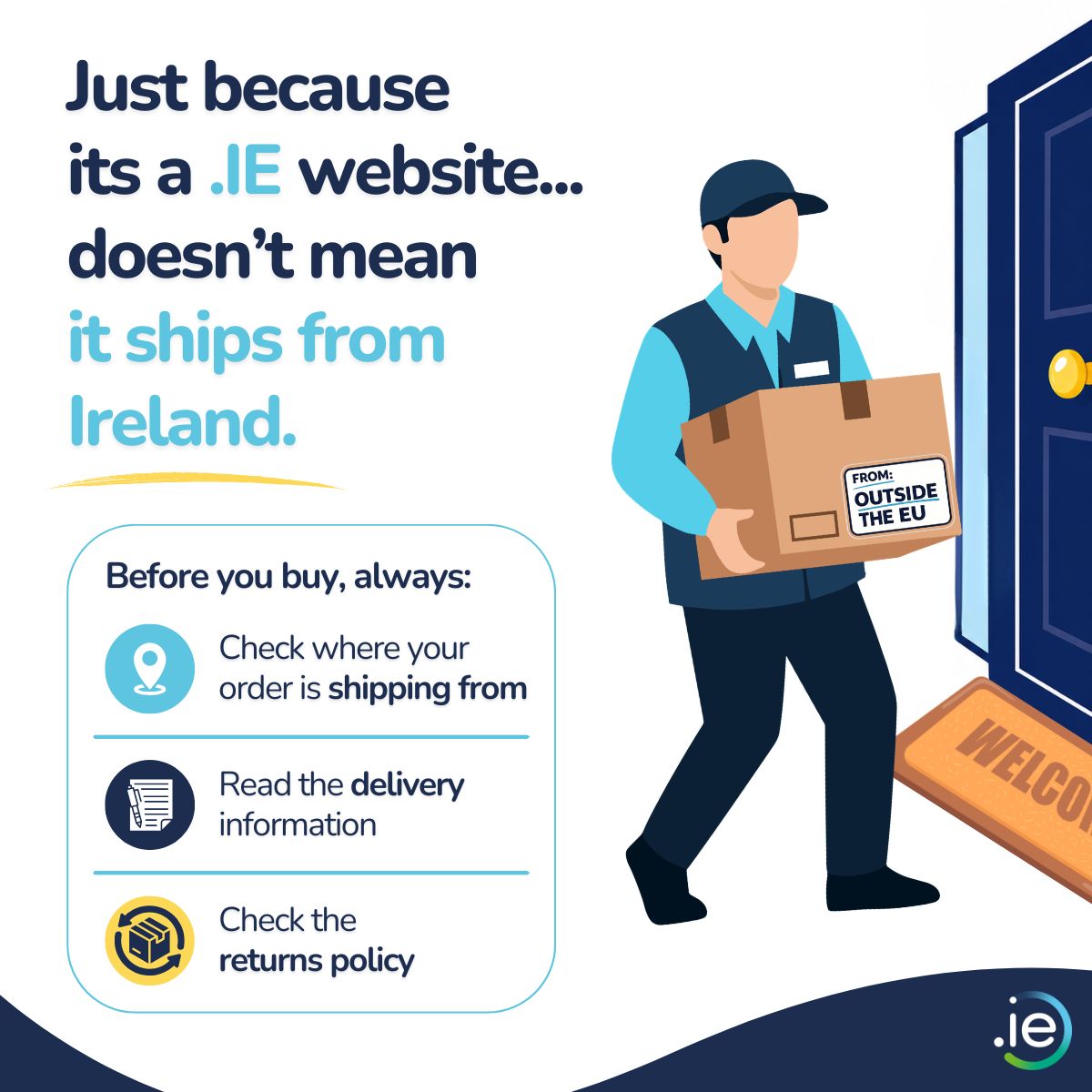
But now, consumers need to pause and ask themselves three simple questions: who am I buying from, where is it shipping from, and what will the final cost be when it lands at my door?
As consumers adjust to the new customs arrangements, understanding where a retailer is based is only one part of the picture. Shoppers also need to establish where their purchases are being dispatched from, as this will determine whether additional charges may apply.
A .IE website is a trust signal
A .IE website is a strong signal that there is a real connection to Ireland because .IE is a managed registry, and applicants must demonstrate that connection before they can register the domain.
However, it is important to understand what that trust signal does and does not mean. A .IE website does not automatically mean the goods are sitting in a warehouse in Ireland. A .IE domain is a trust signal, not a customs guarantee.
I believe the introduction of the new customs fee will make Irish consumers much more conscious of where they are buying from. That presents a real opportunity for Irish businesses that are transparent about where products are shipped from and communicate clearly with customers before they make a purchase.
Irish businesses also need to ensure that pricing and product information on their websites accurately reflect any changes that may affect customers.
If products are being shipped from warehouses outside the EU, businesses should review and update their pricing and website information quickly so that customers understand any potential additional costs before completing an order.
Nobody wants a valued customer to be surprised by an unexpected charge after they have already made their purchase.
Don’t shop on autopilot
For consumers, my advice is very simple: don’t shop on autopilot.
If the goods are coming from outside the EU, the €3 charge can apply per item, and a cheap basket can become less cheap very quickly.
Check where the goods are shipping from rather than where the website appears to be based. Many websites have an Irish presence or appear familiar, but the products themselves may still be dispatched from outside the EU.
It is also worth taking the time to read the returns policy. Sending an item back outside the EU can be expensive, and the returns process can often be a clear indicator that products are being shipped from overseas.
Consumers should also be particularly cautious of text messages and emails claiming that customs charges need to be paid.
Never click directly on a payment link contained in one of these messages. Instead, navigate to the official courier website or app yourself.
The Competition and Consumer Protection Commission (CCPC) has made it clear that An Post will never send a clickable payment link by text message for customs charges, and Revenue will never contact consumers seeking customs payments.
Trust your instincts
Changes like this inevitably create opportunities for criminals to send convincing phishing messages that appear legitimate, so it is important to remain vigilant.
Start by checking the website address. A .IE domain is a strong trust signal because it shows the business has a genuine connection to Ireland, but it should be just one part of your decision-making. Also check where products are shipping from, understand the returns policy, and be satisfied that the overall shopping experience feels transparent.
Ultimately, trust your instincts. If the price is unbelievable, the wording is poor, business details are missing, or the site is pressuring you to buy immediately, then exercise caution.
Finally, remember that two heads are always better than one. If you are unsure about a website or an offer, show it to a family member, friend or colleague. They may spot a red flag that you missed.
Who we are
.IE is passionate about enabling and empowering Ireland to leverage the internet for the good of its society and economy. As the trusted national registry for over 340,000 domain names, .IE protects Ireland’s unique online identity and empowers people, communities and businesses connected with Ireland to thrive and prosper online.
A positive driving force in Ireland’s digital economy, .IE serves as a profit for good organisation with a mission to bridge the digital gap in Ireland by promoting basic digital skills, building awareness and helping SMEs adopt digital technologies.